Moving Beyond Chatbots: A Roadmap for Deploying Agentic AI in Enterprise Workflows
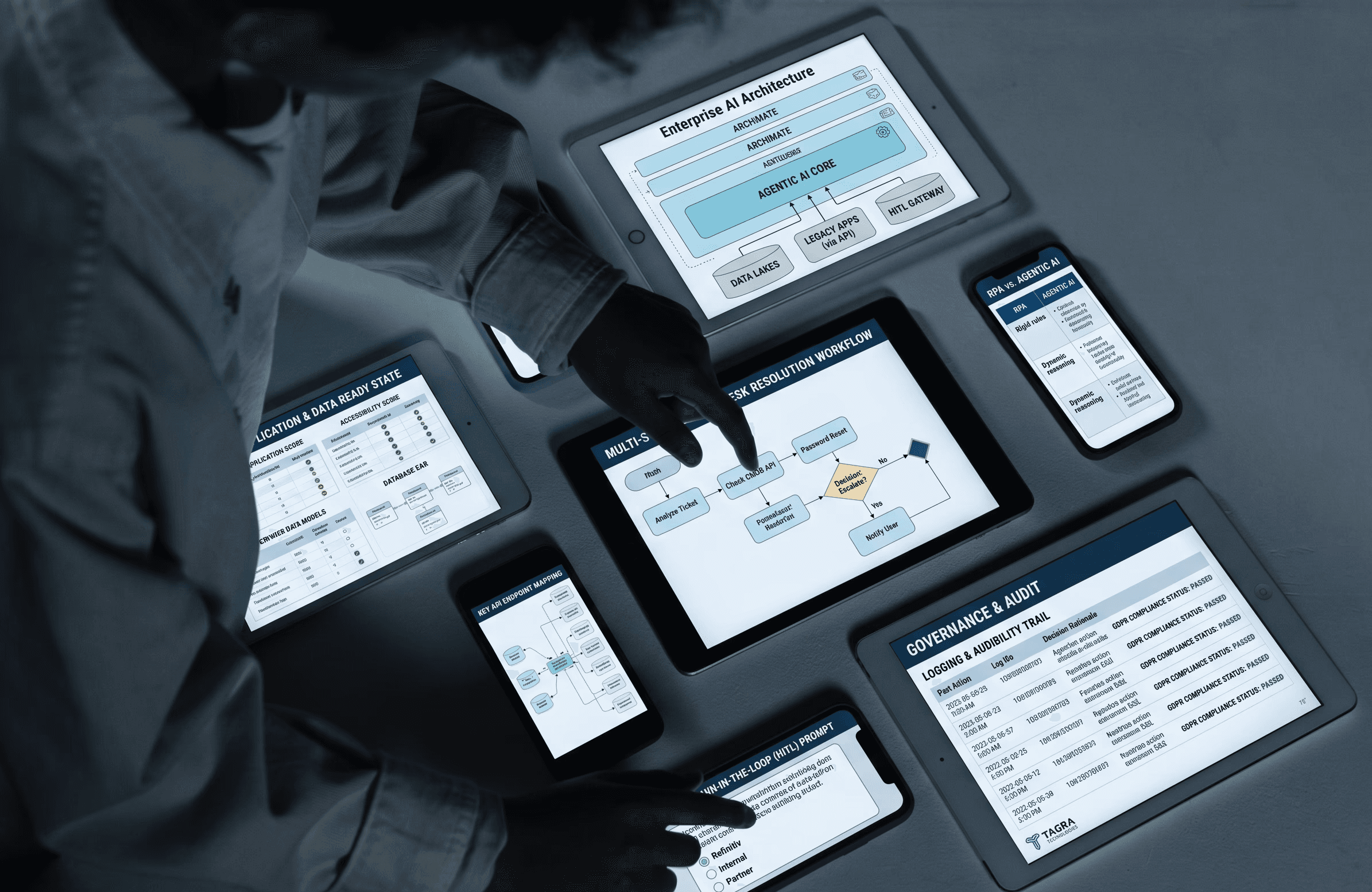
Generative AI has fundamentally changed how businesses interact with data. We are now seeing that generating text or analyzing documents is only the first step. Modern enterprise efficiency requires systems capable of taking autonomous action.
Many organizations struggle to move past basic conversational interfaces. Integrating AI deeply into core operations to execute complex, multi-step tasks remains a significant hurdle. Agentic AI provides the autonomous execution capabilities required for next-level enterprise workflow automation. Successfully deploying these agents requires a structured roadmap rooted in sound enterprise architecture and data governance.
Understanding the Role of Agentic AI
To grasp the value of Agentic AI, it helps to look at how these systems operate. Unlike standard chatbots that simply return information, AI agents can autonomously plan, access external tools, and execute workflows to achieve a predefined goal.
There is a clear spectrum of automation within an enterprise ecosystem. Robotic Process Automation (RPA) handles strict, rule-based, repetitive tasks with high efficiency. Agentic AI steps in to manage dynamic processes that require reasoning, adaptability, and predictive modeling. Implementing these agents correctly drives immense business value, reducing operational bottlenecks and freeing up human talent for higher-level strategic thinking.
Phase 1: Application Portfolio and Data Readiness
An AI agent is only as effective as the data it can access. Before deploying any autonomous system, robust data modeling and clean, structured analytics must be in place.
The first practical step in Agentic AI implementation is evaluating your current application portfolio. You need to determine API accessibility and assess how ready your legacy systems are for integration. Once you understand your technical landscape, you can identify high-impact use cases. Ideal starting points often include automating complex supply chain queries, managing multi-step IT service desk resolutions, or synthesizing massive amounts of ESG data for reporting.
Phase 2: The Architectural Blueprint for Integration
Deploying AI without a map leads to siloed, fragile systems. Utilizing established enterprise architecture frameworks, such as TOGAF or ArchiMate, helps visualize exactly where and how AI agents will interact with your existing infrastructure.
Architecting these workflows requires designing seamless hand-offs between human employees, standard RPA bots, and your new AI agents. Crucially, this phase must establish clear guardrails through "Human-in-the-Loop" (HITL) design. Setting strict scope boundaries and permission levels ensures that AI agents operate safely within designated parameters, escalating to human operators when encountering ambiguity.
Phase 3: Governance, Security, and Compliance
In the Swedish and European markets, strict data privacy is a non-negotiable requirement. Any AI deployment must address the critical need for robust data security, especially concerning GDPR regulations.
Your architecture must include comprehensive audibility and transparency. Logging AI actions and maintaining clear decision-making trails are necessary for compliance and technical troubleshooting. Furthermore, introducing autonomous agents requires deliberate change management. Cultural adoption and clear communication with stakeholders are vital to ensure smooth end-to-end execution and maintain trust in the new automated workflows.
Moving Forward
Deploying Agentic AI is a strategic, architectural initiative that drives significant operational value when planned carefully. By viewing these systems as collaborative tools that empower your workforce, you can move past isolated experiments and achieve genuine enterprise workflow automation.
If your organization is ready to move beyond conversational AI, Tagra Technologies can help guide the way. We partner with IT leaders to conduct comprehensive AI readiness assessments and design predictive AI solutions architecture that aligns with your specific business goals.